Our Services
Supply and Installation of:
Solar Water Heating Systems
Heat Pumps
Swimming Pool Heating Systems
Supply & Installation of New Geysers
Replacement of Burst Geysers
Repairs & Service of
Existing Solar Water Heating Systems
Issue of PIRB (Plumbing)
Certificates of Compliance
Our Products
Heat Tech SABS-approved Geysers
Kwikot Solar Evacuated Tube Collectors
Kwikot Heat Pumps
Geyserwise TSE & Max Geyser Timers
Mixing Valves
Air Release Valves
Banjo Valves
Silicone Inserts
12V DC Solar Pumps
10W PV (Photovoltaic) Panels
Solar Water Heating Systems
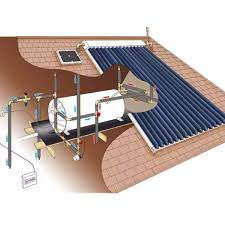
Conversion of
Existing Electrical Geyser
to Solar Water Heating

Thermo Siphon
Solar Water Heating System
Solar Water Heating is the heating of water with solar energy using solar thermal collectors.
A solar thermal collector is installed on top of the roof. The collector absorbs sunlight during the day which results in heat. The heat is passed to a geyser by means of the "thermo siphon effect" or a 12V DC solar pump with a 10W PV panel. A Geyserwise TSE or Geyserwise Max with a 7A 12V Battery can be installed which functions as a timer. A mixing valve is installed to prevent scalding as a result of very hot water. An air release valve is installed to release excess air to maximise system performance.
An evacuated collector consists of an anodized aluminium frame and manifold, and solar vacuum tubes. In a direct solar water heating system the water circulates from the geyser through the collector's manifold and back to the geyser. Each vacuum tube consists of two glass tubes manufactured from borosilicate glass. The outer glass tube is transparent allowing light rays to pass through it with minimum reflection. The inner glass tube is coated with a solar special selective coating (AI-N/A1) which provides excellent solar radiation absorption. The top of the two vacuum tubes are fused together and the air is extracted, which forms a vacuum and is key to the efficiency of the vacuum tubes. To maintain the vacuum between the two vacuum tubes, a barium getter is used. The barium layer also provides a clear visual indication of the vacuum status. The silver coating will turn white if the vacuum is ever lost. Inside each vacuum tube is a copper heat pipe. The top part of each heat pipe is connected to a copper heat exchanger (manifold). The heat energy of the hot vapour inside the vacuum tubes is transferred to the water flowing through the manifold to and from the geyser.
Thermo Siphon Solar Water Heating System
Both the geyser and solar thermal collector are installed outside on top of the roof. The geyser is installed higher than the solar thermal collector. In case of a flat roof, a flat roof geyser stand is installed. Because of the "thermo siphon effect", no circulation pump is needed.
Split Pumped Solar Water Heating System (including Conversion of Existing Electrical Geyser)
Only the solar thermal collector is installed outside on top of the roof. The geyser is installed inside the roof or against a wall, lower than the solar thermal collector. In case of a flat roof, brackets are used to install the solar thermal collector at an angle. A pump is needed to circulate cold water from the geyser to the collector and hot water from the collector back to the geyser. The pump can be either a 12V DC solar pump or a 220W AC electrical pump.
Heat Pumps

A heat pump is a device used to "pump heat" into water.
Heat is transferred from the outside air into the water inside the geyser by means of a fluid ("refrigerant"). The temperature of the refrigerant is lower than that of the ambient air. As the refrigerant passes through the evaporator, heat is exchanged as the refrigerant is heated and the air cooled. Heat transfer is improved by a fan which increases the evaporator's air flow rate. The refrigerant starts to boil and turns into a gas. The gas is compressed by a compressor until it reaches a temperature higher than that of the water inside the geyser. The gas is then pumped into a condenser which transfers the energy from the warm gas into the water. Condensation takes place and the gas becomes a fluid ("refrigerant") again. The refrigerant passes through an expansion valve and its temperature is reduced to a temperature lower than that of the ambient air. The process then repeats itself.
Plumbing (PIRB)
Certificates of Compliance
A PIRB CoC (Certificate of Compliance) is a self-certification and declaration by a PIRB Licensed Plumber that the work undertaken by them is up to standard and professionally conducted as per their training.
A Certificate of Compliance (COC) is required for most plumbing work where the total value of the work, including materials, labour, and VAT, exceeds R1,500.00. It is also required, regardless of cost, with the installation, repair, or replacement of Electric Water Heating Systems; Hot Water Solar Water Heating Systems; Heat Pump Water Heating Systems; and the construction, installation, or alteration of any above or below-ground sanitary drain.
Part of the Plumbing Industry Registration Board's (PIRB) purpose is to monitor compliance of a plumber's work. Through the CoC process, 5% of all a plumber's work is physically audited and if required the plumber is notified of any non-compliance. This physical audit and the associated administration functions bear a cost that is recovered through the associated cost of the PIRB CoC. The cost of the CoC has always been kept as low as possible without jeopardising the mandated functions of the PIRB and that of being a registered professional body.
Licensed plumbers have not only met the prescribed requirements of PIRB registration but have undertaken and passed the required PIRB assessment. Furthermore, licensed plumbers have maintained their prescribed 25 CPD points throughout their registration cycle.
In terms of the PIRB requirements and a licensed plumber maintaining their PIRB registration, a licensed plumber must issue a CoC on all plumbing work undertaken by them which, includes but is not limited to geysers, solar water installations, heat pumps, etc.
As the name implies, a non-compliance notice is a notice that will give notice of any non-compliance issues. In the case of plumbing, it is a requirement that a plumber undertaking plumbing works, is required as part of the work to notify the homeowner (consumer) of any issues of plumbing non-compliance. This notification must be done in writing. The homeowner is responsible for fixing and carrying the cost of the non-compliance. It is the responsibility of a professional plumber to draw attention to the pre-existing non-compliance and the risk associated with it.